http://curiosity.discovery.com/question/apollo-8-successful-moon-orbit
http://www.lpi.usra.edu/expmoon/Apollo8/Apollo8.html
http://www.nasm.si.edu/collections/imagery/apollo/as08/a08sum.htm
Wednesday, December 21, 2011

Conclusion

Overall the astronauts were successful. They were the first astronauts to see the lunar up close. They were about 60 miles away. . They spent the time photographing the lunar surface and studying future Apollo landing sites. They also were the first people to see the Earth rise above the lunar horizon. Early Christmas morning, the moment of truth came; they fired the engine to leave lunar orbit.
Data
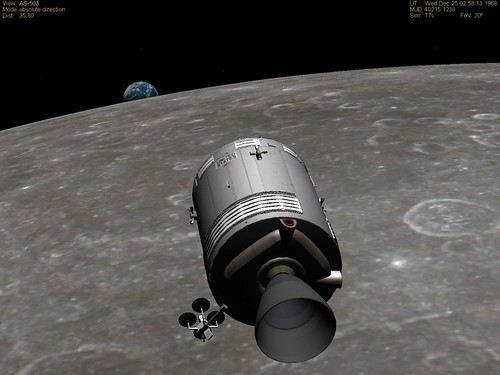
The Spacecraft was placed in an elliptical lunar orbit at 69 hours 8 minutes after liftoff. After flying two elliptical orbits of 168.5 by 60 nautical miles with an inclination of 12 degrees to the Equator, the spacecraft was placed in a nearly circular orbit of 59.7 by 60.7 nautical miles in which it remained for eight orbits. The first flight to take the men to the moon was a bold step forward to the development of lunar landing capability. . With only minor problems, all spacecraft systems operated as intended, and all primary mission objectives were successfully accomplished.
There was a timeline for the Apollo 8 to indicate the the events.
Mission Event List and Timeline
| EVENT | DATE & TIME (EST) | MISSION TIME |
| Launch | December 21 07:51:00 am | 00:00:00 |
| Earth orbit insertion | 08:32:35 am | 00:11:35 |
| Translunar injection | 10:41:37 am | 02:50:37 |
| Lunar orbit insertion | December 24 04:59:20 am | 69:08:20 |
| Transearth injection | December 25 01:10:16 am | 89:19:16 |
| Splashdown | December 27 10:51:42 am | 147:00: |
Introduction
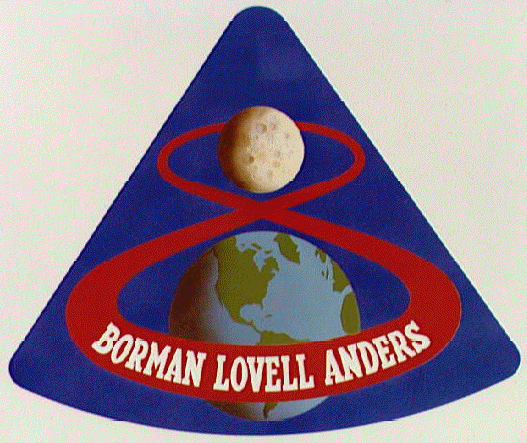
Apollo 8 was launched in Cape Kennedy, Florida at 7:50 AM on December 21, 1968. Two hours 50 minutes later, translunar injection was performed; and astronauts Col. Frank Borman, the commander; Capt. James A. Lovell, Jr., the command module pilot; and Major William A. Anders, the lunar module pilot, were on their way to the Moon. Overall objective of the mission was to demonstrate command and service module performance in a between the Earth and Moon and lunar-orbit environment, to evaluate crew performance in a lunar-orbit mission, to demonstrate communications and tracking at lunar distances, and to return high-resolution photography of proposed Apollo landing areas and other locations of scientific interest.

Subscribe to:
Comments (Atom)